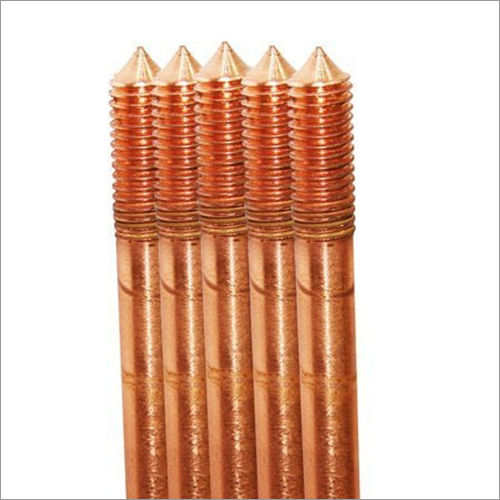
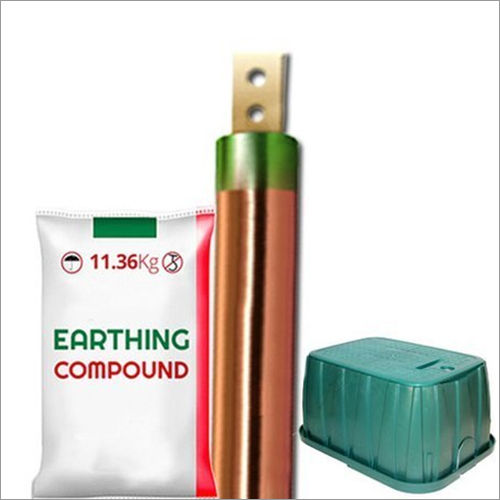
About Copper Earthing Rods
Specification
| Length Of Rod | 2 Meters |
| Thickness | 250 microns (coating) |
| Usage/Application | Maintenance Free Earthing Rod |
| Material | Copper |
| Diameter | 16mm |
| Service Life | 7-10 Years |
| Brand | Electrogrip |
| Country of Origin | Made in India |
Superior Conductivity and Corrosion ResistanceCrafted from high-purity electrolytic copper, these earthing rods ensure optimal electrical conductivity and stable performance in demanding outdoor environments. The solid copper construction offers full thickness for longevity and is highly resistant to corrosion, making them ideal for both lightning protection and substation earthing.
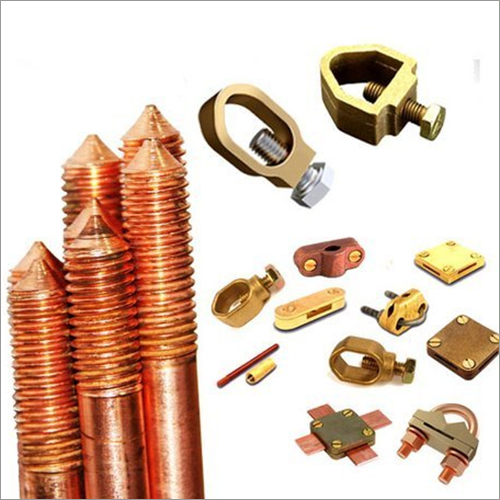
Versatile, User-Friendly InstallationFitted with rolled threads and designed with a pointed tip, these rods are simple to install using standard hammers or hydraulic drivers. The coupler/joint system allows easy extension to the desired length, streamlining installation without compromising on safety.
Applications Across SectorsDesigned to serve diverse needs, Copper Earthing Rods are widely used in electrical substations, industrial units, and domestic installations across India. Their strong mechanical properties and excellent current-handling capability (up to 70 kA) make them a preferred choice for distributors, exporters, and suppliers alike.
FAQ's of Copper Earthing Rods:
Q: How are copper earthing rods typically installed?
A: Copper earthing rods are installed by driving them into the ground using a hammer or, for tougher terrain, a hydraulic driver. Their pointed ends facilitate easy soil penetration, while rolled threads and couplers make extension and adjustment straightforward.
Q: What benefits do solid copper rods provide for electrical grounding?
A: Solid copper rods offer superior conductivity and excellent corrosion resistance, ensuring minimal resistivity and long-lasting grounding performance-essential for safety in substations, industrial sites, and homes.
Q: When is it necessary to use jointed (coupler-extended) earthing rods?
A: Jointed or coupler-extended rods are used when deeper soil layers must be reached for optimal conductivity or to meet specific regulatory requirements for earth resistance in a given installation.
Q: Where can these copper earthing rods be applied?
A: These rods are suitable for use in electrical substations, industrial plant earthings, lightning protection systems, and domestic electrical grounding setups across varied geographical conditions in India.
Q: What is the process for connecting multiple rods to achieve greater length?
A: To extend rod length, simply use the threaded coupler or joint provided. Securely screw the rods together to form a continuous, strong, and conductive earth electrode system.
Q: What is the lifespan and durability of these rods?
A: Copper earthing rods are engineered for longevity, with a life span of over 30 years, high mechanical strength, and resistance to harsh environmental factors like corrosion and temperature variations.
Q: What are the electrical and physical specifications available for these rods?
A: Standard lengths are 1.5m, 2m, and 3m, with diameters such as 14mm, 16mm, 19mm, and 25mm. Each rod is manufactured to a tolerance of 0.5 mm and features tensile strength 350 N/mm2 with solid copper throughout its cylindrical body.
 Call Us : 08045477535







 Send Inquiry

 Send Inquiry
 Send Inquiry
 Send SMS
 Call Me Free